BioMARató 2025: Key Highlights and Results
Coordinated by the EMBIMOS Group of the Institut de Ciències del Mar (ICM-CSIC), the fifth edition of the BioMARató has achieved impressive results - gathering biodiversity data of the entire Catalan coastline, all thanks to citizens’ active engagement. Alongside the full spatial coverage, this year’s edition has also been marked by an increase in both participation and overall results. In fact, between May and October, more than 520 participants uploaded 94,000 observations on the MINKA platform, with around 2,040 species identified in total, that is nearly 300 more than last year. These results show a gradual increase in species documented, bringing the initiative closer to the establishment of tools necessary for the long-term monitoring of biodiversity.
This year, the ANERIS-supported BioMARató brought together several institutions, collaborating to provide community-driven and knowledge-based training to marine enthusiasts in the Catalan coastal area: such include the Catalan Federation of Underwater Activities (FECDAS), the association Oceánicos, Plàncton Diving, Anèl·lides – Serveis Ambientals Marins, and Xatrac, most of which specialise in organising diving, snorkelling and underwater activities.
Another remarkable milestone achieved during BioMARató 2025 is the amount of new records found along the Catalan coast. For example, the crab Afropisa carinimana was for the first time observed this year in the area of Canet de Mar. Recorded by Enric Badosa, participant in BioMARató 2025, this species originates in tropical Atlantic coasts and constitutes the first northernmost record in the Mediterranean. Additionally, the BioMARató 2025 further proved its crucial role in expanding knowledge-exchange and raising awareness on ocean conservation, by incorporating 159 new observations of coastal plants into its database within the event, despite being previously documented in Catalonia.
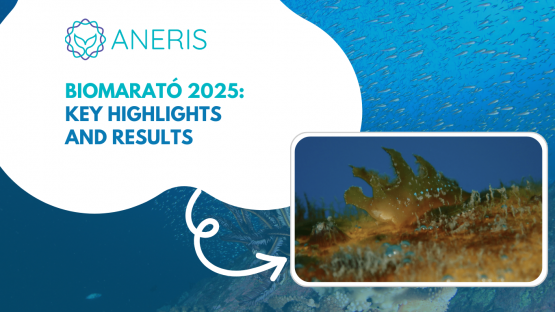
This year’s citizen observations have also detected an expansion of tropical and subtropical species. The Atlantic parrotfish (Sparisoma cretense) and the sargassum nudibranch (Scyllaea pelagica) are such examples, both of them being observed previously during the 2023 and 2024 edition. Their presence in the western Mediterranean waters suggests that this phenomenon might be connected to rising sea temperatures. Other consequences of ocean warming are changes in biological cycles and natural behaviours of species. For instance, the unusually early flowering of Posidonia oceanica on 7 September in Cala Montgó, and then a week later in Cadaqués, recorded by participant Ferran Roure. Also, persistent warming has also led to the infection of dusky grouper (Epinephelus marginatus) betanodavirus, a pathogen that affects multiple fish species in warmer waters.
Overall, BioMARató 2025 was also particularly successful in collecting observations of stingrays and mantas, with almost 400 records of elasmobranchs, representing 14 different species across the three Catalan provinces. Interestingly, the spiny butterfly ray (Gymnura altavela), although historically rare in the Catalan area, was recorded 15 times, even in the province of Girona, where it had never been observed before during previous BioMARató initiatives. However, the rising numbers of observations does not always count for a growing abundance of individuals interested in marine biodiversity mapping. It can simply indicate increased activity among participants, along with improved coastal coverage, all thanks to citizen participation.
To find out more details about this year’s edition of the BioMARató, read the full press release, published by CSIC-ICM here.